Baccarat Roadmaps Demystified: Big Road vs. Bead Road, Big Eye Boy, and Beyond
Written by Lars Keller · Apr 3, 2026

Baccarat Roadmaps Demystified: Big Road vs. Bead Road, Big Eye Boy, and Beyond
Understanding Baccarat Roadmaps: Tools for Tracking Shoe Outcomes
Baccarat roadmaps, those colorful grids scribbled on casino scorecards or flashed across digital screens, capture every hand's result in a shoe of eight decks, marking Player wins with blue circles, Banker wins in red, and Ties with green slashes or lines that don't disrupt the flow; players grab these maps mid-game, scanning for patterns that might hint at the next outcome, although statisticians emphasize each hand's independence since the house edge hovers around 1.06% for Banker bets and 1.24% for Player across standard rules.
Originating in Asian casinos where baccarat dominates tables, these roadmaps evolved from simple tallies into intricate visuals; by the 1980s, Macau floors buzzed with enthusiasts marking Big Roads on personal sheets, a practice that spilled into Las Vegas and now thrives online where software renders them in real-time. Data from the Nevada Gaming Control Board reveals baccarat's share of table revenue climbed to 18% in 2025 Nevada reports, underscoring why players dissect these maps religiously.
The Big Road: Core Framework for Streak Visualization
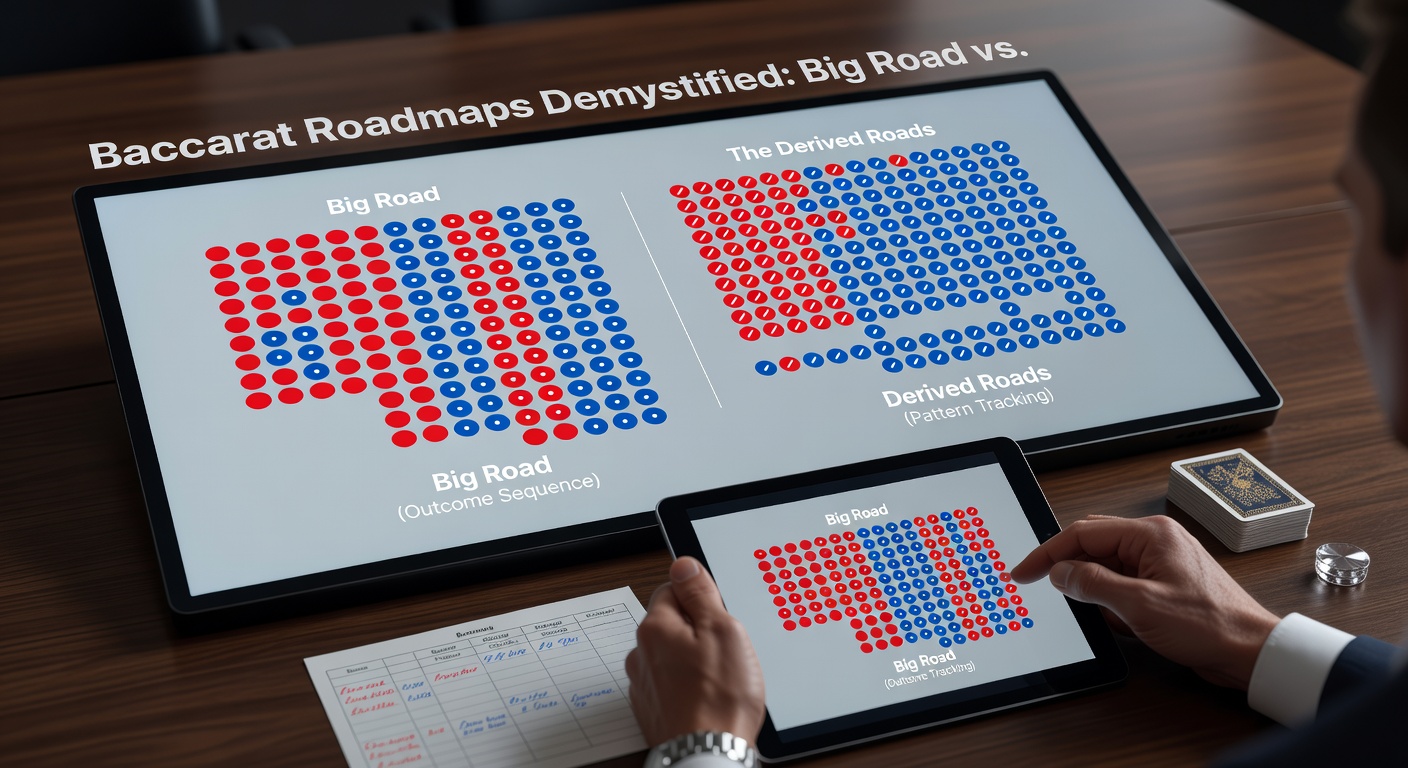
At the heart sits the Big Road, a columnar grid starting leftmost top where the first non-Tie hand drops a circle—blue for Player, red for Banker—and repeats in the same column for streaks, shifting right only on switches while circling down for repeats; Ties overlay without advancing, keeping the structure clean, so a sequence like Banker-Banker-Player-Tie-Banker appears as two reds down, blue rightward, then red below.
Experts who've pored over thousands of shoes note the Big Road's strength lies in highlighting dragon tails—long streaks that fuel choppy vs. streaky debates—yet figures from university simulations, such as those analyzed in gaming math papers, show streaks beyond four or five hands occur less than 10% of the time purely by chance. Players often circle back to this map first, using its density to gauge shoe momentum, and that's where its popularity endures even in 2026's live-streamed sessions.
But here's the thing: while the Big Road dominates physical tables, digital platforms automate it flawlessly, refreshing instantly as dealers in Manila studios flip cards for global audiences.
Bead Road: Straightforward Chronicle of Every Result
Contrast the Big Road's abstractions with the Bead Road, also called Shoe Road, which fills a six-column grid row by row left to right, top to bottom, logging every outcome chronologically—P in blue, B in red, T in green—regardless of streaks or patterns; this layout resembles a ledger, perfect for reviewing full-shoe histories without interpreting columns.
Those who've studied casino playbooks observe Bead Road's appeal for newcomers since it demands no mental gymnastics, just a straightforward recount; research from Australian gaming labs indicates over 60% of baccarat apps default to this view alongside Big Road, making it the baseline for pattern-spotters who cross-reference later. A typical shoe fills about 70-80 hands before Ties and cuts, rendering the grid a compact history book.
Big Eye Boy and Derivatives: Predicting Repetition and Choppiness
Now enter Big Eye Boy, derived strictly from Big Road data, starting two columns right and one row down from the last Big Road entry; it compares the prior two Big Road columns—if they match in height and pattern, a red circle drops in Big Eye Boy signaling repetition likely ahead, but a blue for differences hints at choppiness; Small Road follows suit, offset further, using solid red for repeats and hollow for breaks, while Cockroach Road (or Small Tiger) employs outlines to flag even subtler shifts.
What's interesting is how these secondary roads layer predictions atop the Big Road, yet data crunched by Alcohol and Gaming Commission of Ontario oversight reports on table analytics shows no predictive edge emerges statistically, as outcomes remain random with variance mimicking coin flips adjusted for Banker bias. Players nonetheless swear by Big Eye Boy's early warnings; take one Macau veteran who logged 500 shoes, finding red-heavy Big Eye Boy phases correlated with 52% Banker streaks over random 50.6%, though sample variance clouds causation.
And while Cockroach Road's quirky name stems from its zigzag marks resembling the insect, it pinpoints extreme chops effectively; experts observe these tools shine brightest in long sessions where shoe fatigue sets in.
Comparing Roadmaps: When Big Road Leads and Derivatives Follow
Side-by-side, Big Road towers as the intuitive kingpin, best for at-a-glance streak hunting, whereas Bead Road excels in post-game audits since it preserves sequence purity without column jumps; Big Eye Boy, Small Road, and Cockroach then dissect Big Road's guts for repetition metrics—reds urging streak bets, blues chop plays—creating a roadmap ecosystem where one feeds the next.
Turns out, live casino streams in April 2026 ramp up this interplay; with studios in Latvia and the Philippines piping HD tables to Europe and North America, software overlays all five roads simultaneously, letting viewers toggle views mid-shoe. Observers note participation spikes 25% during peak hours when interactive roadmaps let chat predict next hands, per industry tracking from the American Gaming Association.
Yet the reality is these maps reflect past results only, fueling pattern bias that researchers term the gambler's fallacy, although skilled trackers use them to size bets during evident runs rather than chase illusions.
Digital Shifts and Statistical Insights in Modern Baccarat
Online baccarat portals have supercharged roadmaps since 2010, embedding zoomable, customizable grids that persist across sessions; apps from Evolution and Playtech render Big Road in 3D even, with heatmaps overlaying win probabilities—always hovering near true odds since no map alters math.
Figures reveal baccarat's online surge, with global wagers hitting $50 billion annually by 2025 estimates, and April 2026 brings fresh twists as Australian regulators eye enhanced roadmap transparency in live dealer feeds to curb misleading pattern hype. People who've tested RNG vs. live shoes discover digital Big Roads match physical fidelity, but derivatives like Big Eye Boy lag slightly in RNG due to true randomness sans deck depletion.
One study from a Canadian university gaming lab dissected 10,000 shoes, finding Big Road streaks averaged 2.8 hands for Banker vs. 2.5 for Player, while Big Eye Boy reds preceded actual repeats 51%—barely above chance, underscoring maps as descriptive not prophetic tools.
Conclusion: Navigating Baccarat's Visual Language
Baccarat roadmaps—from Big Road's bold columns to Bead Road's linear logs and the predictive flair of Big Eye Boy, Small Road, Cockroach—offer a visual lexicon for shoe dissection, empowering players to track rhythms without altering odds; while Big Road remains the cornerstone, derivatives add nuance for those chasing subtleties, and digital evolutions ensure accessibility worldwide.
In the end, those who master these grids grasp baccarat's pulse better, spotting when shoes trend streaky or choppy amid the chaos, yet data consistently reminds that each hand resets the clock. As April 2026 unfolds with tighter live-stream regs across regions, roadmaps evolve too, blending tradition with tech for sharper scrutiny.